



Contact

oval design doodle position bottom-left Confessions from Spreadsheets Anonymous

Confessions from Spreadsheets Anonymous (and the way out)

A practical guide to getting IT budgeting and forecasting out of “Final_v9_REALLY_FINAL.xlsx”

When Spreadsheets Stop Helping IT Planning

Spreadsheets are usually the starting point for IT planning because they’re fast, flexible, and familiar. But as IT environments grow more complex and planning becomes more collaborative, spreadsheets quietly shift from a helpful tool into a fragile process.

This eBook explores how to recognize when spreadsheets have reached their limit—and what a more sustainable approach to IT planning looks like once they have.

IT Budgeting

Why Spreadsheets Stall Planning

Speed, accuracy, and trust break down at scale

Let’s be honest: spreadsheets are fantastic for analysis and quick “what happens if…?” noodling. But once you try to run an enterprise IT planning cycle in them—across dozens of budget owners, thousands of line items, shifting headcount, contracts and renewals, cloud commitments, and allocations—the wheels wobble.

To put a financial lens on the problem, this could result in millions of dollars of wasted labor hours, misaligned costs driving the wrong business decisions and tens or hundreds of millions of dollars of capital not being deployed against strategic priorities.

Here are some of the top reasons why spreadsheets stall planning:

  • IT planning needs detail that spreadsheets can’t carry
  • Version sprawl and errors block a single source of truth
  • Answers that should take minutes, take weeks
  • Rolling and multi-year planning breaks down in spreadsheets
  • See eBook for full list
Portrait of IT employee

Plan Like IT, Reconcile Like Finance

How ITFM translates intent into finance-ready outputs

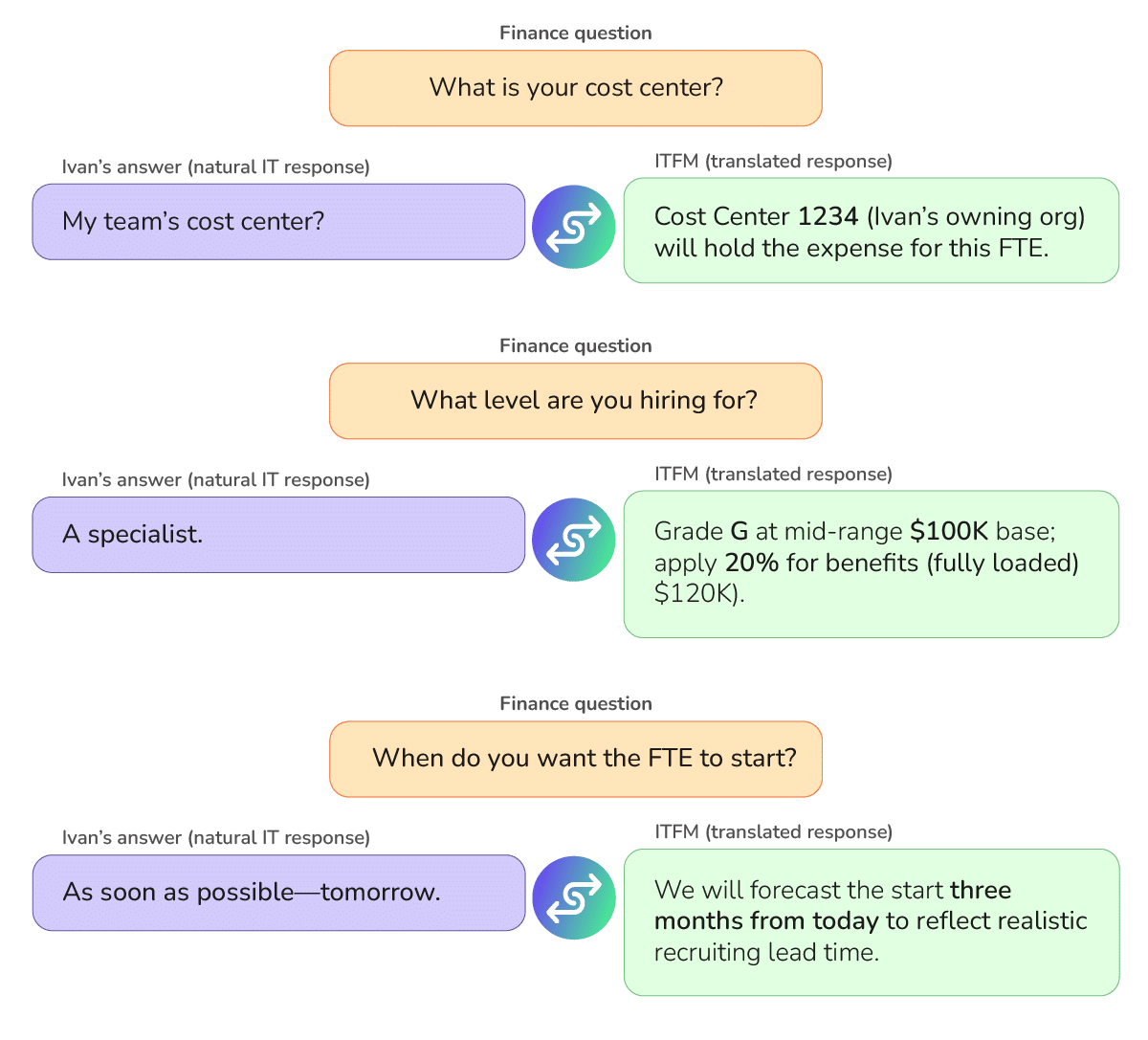
IT and Finance are solving the same problem from different directions. IT thinks in services, applications, business capabilities, infrastructure, vendors, and people. FP&A needs cost center and account by period. The translation step—done well—turns IT’s operational intent into numbers Finance can book and defend, without losing the detail IT needs to run.

This translation is where spreadsheet-based processes most often fail. A more sustainable approach treats translation as a repeatable pattern, not a manual rebuild, allowing IT and Finance to work from the same plan without compromise.

A Real Translation in Practice

Scenario: Ivan needs to hire an additional FTE…

Result: ITFM Sends the Request to Finance as:

Spreadsheets to ITFM

From Spreadsheets to an ITFM Platform

Separating analysis from process

Moving IT planning into an IT Financial Management (ITFM) platform does not mean abandoning spreadsheets entirely. Instead, it means redefining their role. Spreadsheets remain valuable as personal analysis tools, while the planning process itself—intake, approvals, versioning, and publishing—moves into a governed environment.

In this model, changes are captured once, reviewed in context, and published with clear ownership and timing. Budget owners work in familiar operational terms. IT finance teams apply guardrails. Finance receives consistent, reconcilable outputs. Most importantly, everyone works from the same version of the plan.

Best-in-Class IT Planning

What “good” really looks like

Best-in-class IT planning isn’t defined by a tool or a template—it’s defined by outcomes. In mature organizations, planning is no longer an annual scramble or a quarterly reset. It becomes a repeatable process that supports decisions throughout the year, even as priorities and assumptions change. Here’s a snapshot of what you should be aiming for:

Best in Class IT Planning

At this level, teams spend less time debating which number is right and more time discussing trade-offs, timing, and impact. Forecasts extend far enough to support real decisions, and changes can be absorbed without forcing a rebuild of the entire plan.

Confessions Spreadsheet Anonymous

Want to see how organizations move from spreadsheets to best-in-class IT planning?

Download eBook

Frequently Asked Questions

Do we have to stop using spreadsheets entirely?

No. Spreadsheets are still valuable for individual analysis, ad hoc modeling, and exploring “what-if” ideas. The challenge arises when spreadsheets are asked to function as the planning itself. A more sustainable approach keeps spreadsheets where they excel, while moving planning, governance, approvals, and publishing into a system designed to support them.

How is this different from enterprise planning or FP&A tools we already use?

Enterprise planning tools are designed to roll up numbers across the organization. They are not built to capture the operational detail, assumptions, and timing that drive IT spend. An IT planning approach complements corporate planning by producing finance-ready outputs—mapped, timed, and reconciled—that FP&A can consume with confidence.

Will this create two sources of truth?

No. In a mature planning model, there is one published, locked plan. IT planning produces the detailed, governed number; enterprise planning and FP&A consume it. Different views exist for different audiences, but the underlying number remains consistent and reconcilable.

View More

Get actionable insights and updates about technology financial and business management direct to your inbox.