







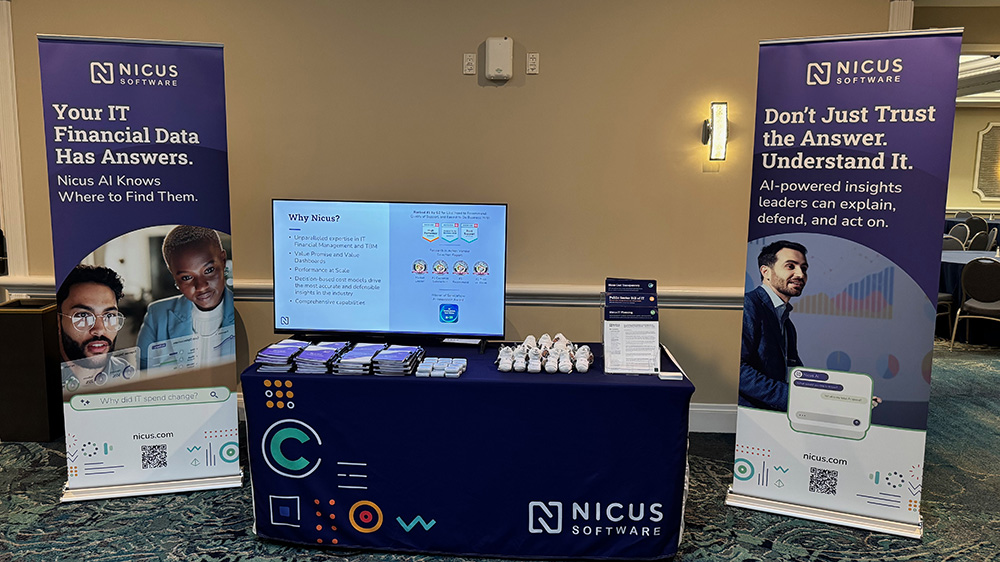
Every year, the IT Financial Management Association brings together the people who run ITFM and TBM programs day to day. That includes the analysts building cost models, the directors connecting IT spend to business outcomes for the CIO, and the state and local government teams doing all of it with fewer resources and more scrutiny. This year’s IT Financial Management Association Conference and Boot Camp was no exception. Nicus had a large presence, running a two-day boot camp and seven speaker sessions, with six of those sessions built entirely around Nicus customers sharing their stories, experience and value their ITFM programs are delivering.
This gave us a close, candid view of where IT financial management practice stands today. Here are five takeaways from ITFMA 2026.
AI in ITFM: From Insight to Action
AI was, by a wide margin, the most consistent theme across this year’s ITFM Association Conference. The discussion was practical rather than abstract or confined to marketing decks. Nicus dedicated three consecutive sessions to it, co-presented by Craig Hollenbeck and Ginger Allen, Senior Director of IT Finance at GuideWell. Together, they walked through how AI applies to three distinct layers of IT financial management: cost transparency, forecasting, and cost optimization.
Across all three sessions, the same point kept resurfacing: AI is only as good as the data underneath it. Cost transparency data grounded in a properly built cost model is exactly the kind of structured, trustworthy foundation it needs. That model must trace every dollar from its original general ledger line all the way up through services to the business capability it supports, without ever dropping that traceability. With a well-governed dataset like that, AI can surface a variance, a driver, or a trend in seconds. Point it at a disconnected pile of spreadsheets and it can produce an answer just as quickly — confident, plausible-sounding, and wrong.
Allen phrased is perfectly: “Cost transparency tells us what happened. AI can tell you what matters and why.” She was equally clear about the limits. Throughout the sessions, she reminded the room that AI is a support system rather than a replacement for judgment. That is a useful check against the two failure modes she sees most often: teams that rush in without governance and teams too anxious about job security to try it at all.
For IT finance leaders, the starting point isn’t which AI tool to buy. Most ITFM platforms can hold data; far fewer are built around the cost-modeling discipline that makes AI worth applying to that data in the first place. Buying a tool doesn’t make someone a skilled cost modeler or IT finance analyst, any more than owning a word processor makes someone an author — the model still has to be built well enough that the business trusts the data and it aligns to how they deliver IT. That discipline is the prerequisite for getting value out of AI in ITFM. It’s been a Nicus focus well before AI became fashionable to talk about.
Excel Works Until It Doesn’t
Ford and BorgWarner didn’t move off Excel because Excel is a bad tool. They moved off it because both companies had grown past the point where a spreadsheet, however well built, could keep up with their scale and complexity. Excel simply isn’t built for hundreds of planners, thousands of cost drivers, and allocation logic that has to hold together across multiple business units, geographies, and stakeholders at once. Organizations eventually hit the ceiling of using Excel regardless of how disciplined they are about maintaining it.
Lisa Hennemann, who leads global IT financial management at Ford, described what that ceiling looked like in practice: hundreds of disconnected Excel spreadsheets scattered across the organization, each built by a different owner with their own business rules, producing conflicting logic nobody could reconcile. Meetings became debates about whose numbers were right rather than what to do next. After consolidating onto a single governed platform (Nicus), Ford’s forecast variance dropped from 6% to under 2% on a $4 billion IT budget, and month-end close shortened by two days. The effect went beyond improved accuracy. Hennemann said planners stopped walking into meetings to defend their numbers and started discussing how to optimize them instead.
BorgWarner ran into the same ceiling from a different direction. Alina Neagu described a budgeting cycle that used to take eight to ten months and six to eight iterations to reach a workable number, running on a legacy platform that took a full day or two just to recalculate after every change. Craig Hollenbeck, introducing the session, framed the real cost the way leadership actually experiences it: not the length of the budget cycle itself, but leadership asking a straightforward question and waiting as long as six weeks for an answer instead of getting one in real time. After automating roughly 300 chargeback services against a shared platform, that same question gets answered close to instantly, and the annual budgeting cycle compressed from most of a year down to about one month of active data entry.
None of this happened because Ford and BorgWarner simply switched tools. The difference came not only from using a platform built for ITFM at scale. Plenty of organizations buy a platform and never see these kinds of outcomes. That’s because the hard work is the methodology, discipline and best practice required to drive commercial outcomes. That includes how the cost model is defined, how allocation logic holds up under scrutiny, and how a model earns trust from finance and the business at the same time. That’s the same discipline Nicus leads through the ITFM Boot Camp, and it’s the difference between owning a software tool and running a mature ITFM or TBM program. The other key component is connecting to business value, the topic of our next takeaway.
IT Finance as a Value Function, Not Cost Police
Doug Chase, IT Finance Manager at COUNTRY Financial, opened his session with an origin story a lot of the room recognized: in 2015, his team couldn’t reliably report what IT had spent the prior month, let alone forecast what came next. A decade later, COUNTRY Financial is generally within a quarter of a percent on IT forecasts. That accuracy is now the foundation for a bigger shift: moving its entire IT budget — not just discretionary spend, but its full portfolio — onto value streams, funded by business outcome rather than by project-by-project political negotiation.
Chase’s operating philosophy was refreshingly blunt: “close enough is good enough.” COUNTRY Financial isn’t aiming for penny-perfect allocation. The goal is directional accuracy that’s defensible enough to drive a real conversation with the business, then move on. When an early attempt to allocate managed-service costs by ticket severity turned into a 45-minute debate over whether a critical incident really costs more than a routine one, the team scrapped the complexity and allocated by simple volume instead. The simpler model held up fine, and it stopped the argument.
That instinct echoed a session from the ITFM Boot Camp earlier in the week, where Craig Hollenbeck framed the same idea more generally: value isn’t price. An IT finance team can report that a cost went from 100 to 105, but the number means nothing to a business leader until it’s translated into language they already use — cost per claim for an insurer, cost per unit for a manufacturer, whatever metric the business is already managing to. Chase’s team gets there by aligning cost centers directly to value streams wherever possible, so funding disputes have a default, defensible answer instead of turning into the kind of annual scramble for discretionary dollars that pits every department leader against the next.
Both sessions pointed to the same shift. IT finance stops being seen as the department that says no once it starts speaking the business’s own language and tying spend to outcomes the business cares about.
Government Moves Slowly — Except When It Doesn’t
Craig Hollenbeck’s session on the State of Arizona, titled “Driving Maturity from Zero to Sixty for a State ITFM Capability,” described a chargeback billing cycle that used to take roughly two and a half months to close (meaning the state was often collecting money after it had already been spent). Service owners had never seen their own actuals or budgets, let alone a forecast. Rate committee meetings routinely stalled because nobody, including IT, could explain what was actually driving a rate increase.
Today, that same billing cycle runs in eight days, on an automated daily schedule. Service owners can see actuals, budget, and a multi-year forecast for their own area. Rate models that used to be static — sometimes unchanged for over a decade — are now dynamic enough to run what-if scenarios before a rate committee meeting rather than defending surprises during one. The state’s cost model used to run through 126 separate calculation steps. Now it runs through three.
In the discussion that followed, and in many interactions across the conference, state, county, and city government attendees described similar challenges in their own organizations, and several expressed interest in following a similar path.
As in the commercial sector, the State of Arizona experience showed that software does not solve this on its own. A proven partner who has already guided other state and local governments through the same maturity path — and knows where organizations get stuck along the way — makes the difference.
The Next Cost Center Nobody Budgeted For: AI Itself
The most unplanned-for line item to come out of this year’s conference wasn’t cloud, and it wasn’t labor. It was AI itself, and multiple attendees hit the same wall independently.
One IT finance leader described their team discovering they’d burn through a month’s AI token allocation by the 12th of the month, with no historical pattern to forecast against and adoption still accelerating. Their fix leaned on work already done elsewhere in the program: because employees were already mapped to value streams for other cost allocation purposes, AI usage could be attributed the same way, by user, almost immediately. What it didn’t solve was forecasting — there’s no prior year of data to extrapolate from when usage is compounding month over month with no ceiling in sight.

Another attendee described running into a version of the same problem from a different direction: a single enterprise-wide AI training rollout, driven by HR, that produced roughly a 300% spike in token consumption in one week — a cost nobody in IT finance saw coming because the trigger came from outside IT entirely.
Several conversations beyond these two examples pointed to an emerging shift. Some organizations that have never charged back IT costs at all — relying on showback, or nothing — are starting to charge back AI specifically because of the dynamics above. That shifts the burden of justifying the spend — and proving the value it delivered — onto whoever asked for it, rather than leaving IT finance to carry an expense it didn’t create and can’t fully explain. Cloud spend went through a similar reckoning several years ago. AI is now having its own version of that moment, on a faster timeline and with far less historical data to plan against.
The Common Thread
These five takeaways cover very different ground: an AI methodology, Ford and BorgWarner case studies, a value-stream transformation, a state government turnaround, and an emerging cost category. Yet they keep returning to the same issue: the gap between simply having data and having a governed, trusted, business-aligned version of it. Every other goal becomes harder without a strong foundation in place first. Related to this is that software alone is not enough. You need the right methodologies, an approach to connecting ITFM to business outcomes and a proven maturity path that enables you to iterate and get better over time.
It’s also worth a brief note on where FinOps fits into this picture, since it came up throughout the conference and continues to evolve. The FinOps Foundation’s scope has been expanding well beyond its original cloud-cost roots, and Nicus is part of that conversation directly, including participation in a FinOps Foundation working group focused on how FinOps and IT financial management fit together. That’s a topic substantial enough to deserve its own dedicated discussion rather than a paragraph at the end of a conference recap (expect more from us on it).
If any of these five takeaways sound like where your own organization is stuck, that’s a fairly common starting point, and it’s exactly the kind of conversation Nicus has with IT finance and CIO teams every day. Reach out to talk through what a maturity path could look like for your team. A conversation costs nothing!
Nicus ITFM Platform: Recognized by Gartner, Nicus offers industry-leading ITFM software that helps companies achieve true IT cost transparency and ensures every IT dollar delivers value, maximizing return on investment.